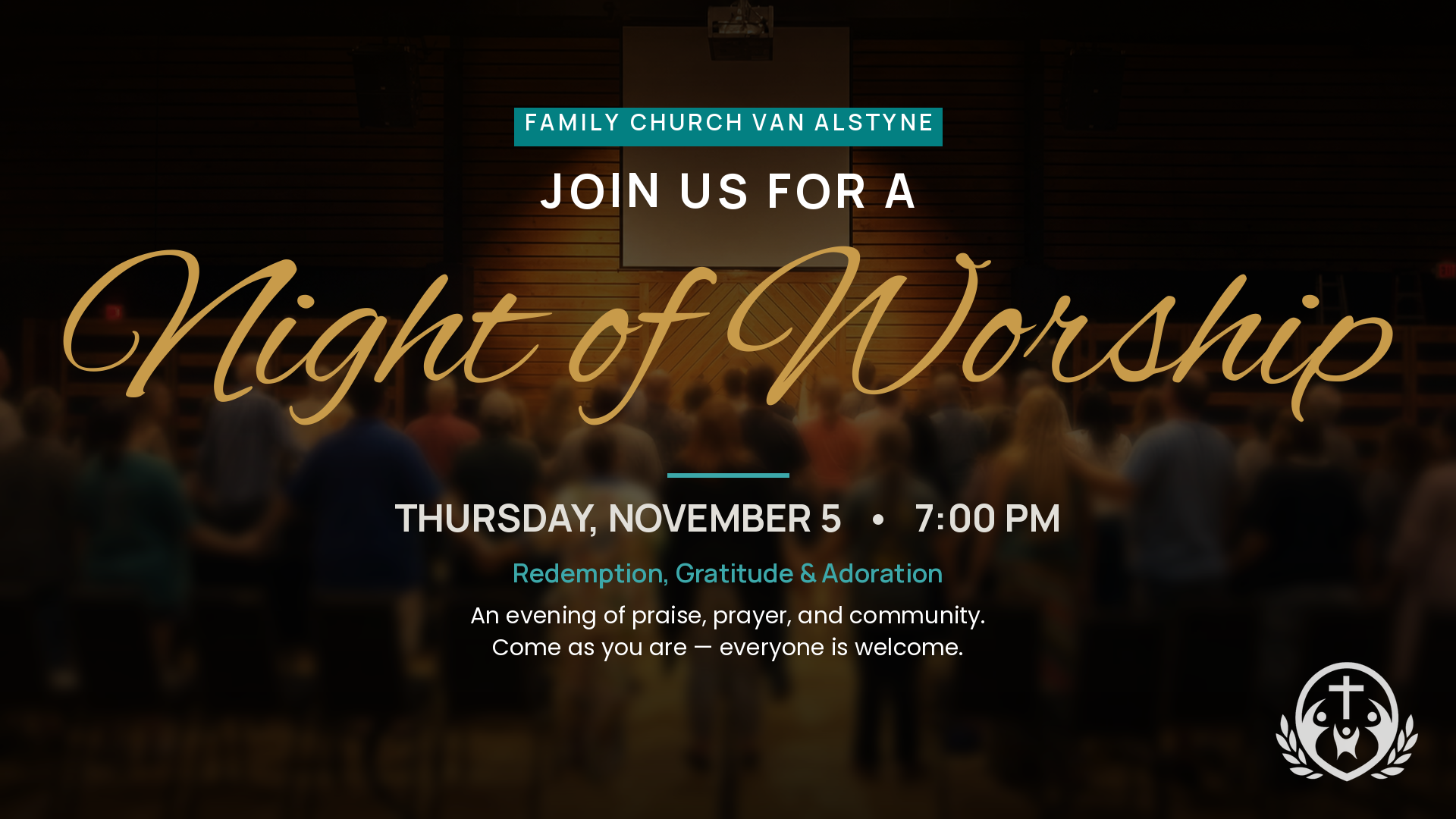
Devotional #2 for our November 5th Night of Worship.
An unshakeable kingdom, and the thanks that belongs to it.
Songs from the November 5 service:
Gratitude is not a mood. It is the right answer to a gift you did not earn, offered by people who have run out of adequate words.
The writer of Hebrews does not begin with a feeling. He begins with a fact. “Therefore, since we receive a kingdom which cannot be shaken, let’s show gratitude, by which we may offer to God an acceptable service with reverence and awe; for our God is a consuming fire” (Hebrews 12:28–29). Therefore. The thanks sits downstream of a kingdom already received. Not a kingdom we stabilized. A kingdom that cannot be shaken, given to people who could not build it. Gratitude is what obedience looks like when you have stopped pretending you are the one holding the structure up.
And the words do run out. That is not false modesty. It is accuracy. All my words fall short. I have nothing new. How do you express a debt this size? I could sing the songs I know, as I often do, but every song must end, and He never does. So the honest move is a small one. Hands up. Again. A hallelujah, and then another, because a heart singing hallelujah is the only thing I have that is fit for a King. David knew the limit and did not let it silence him. “What shall I repay to the Lord for all His benefits to me? I will lift up the cup of salvation, and call upon the name of the Lord” (Psalm 116:12–13). The repayment is not a payment. It is a return to the gift. One response. One move. Praise, offered by someone who has already admitted the offering is not impressive.
That praise has to be aimed at holiness, or it shrinks into a thank-you note for a convenient week. A thousand generations have already fallen down to sing the song of ages to the Lamb. All who have gone before us, and all who will believe, are in the same song. His name is the highest. It stands above every throne, every dominion, every power and position. The angels are not finished saying holy. They are telling the truth about a God whose worth does not rise and fall with our week. “Holy, holy, holy is the Lord of armies; the whole earth is full of His glory” (Isaiah 6:3). Isaiah answered that sight with ruin, not a list of blessings (Isaiah 6:5). If you have been forgiven, if you have been set free, you do not start the song. You join it. He is holy forever, which means He is holy when the sentence comes easily and when it does not.
Who can stand before mercy like that? It is an ocean, and it does not narrow for the impressive. Not a soul could earn the favor. Still He calls us to His side. Holy fire that does not falter. Perfect justice, and perfect grace, from a throne of matchless glory. We are unworthy, yet chosen. Unclean, yet embraced. Beauty unbroken. The Ancient of Days. We fall at the altar. Mercy still reigns. Every crown goes down in silence. Every kingdom we trusted fades to dust. Only He remains unshaken, ever faithful, ever just. Not for what our hands have done. Not for songs, and not for sacrifice. For a love past reason, He brought the dead to life. That is why we say worthy always, and why the “we” matters. We are not conferring worth. We are the ones on our faces, agreeing with what He already is. “Worthy is the Lamb that was slaughtered to receive power, wealth, wisdom, might, honor, glory, and blessing” (Revelation 5:12). “Jesus Christ is the same yesterday and today, and forever” (Hebrews 13:8).
Most of what we usually thank God for lives in the shakable pile. Health. Work. A quiet house. A week that did not come apart. Those are real mercies. “Every good thing given and every perfect gift is from above” (James 1:17), and we should say so. They are still not the kingdom. If your gratitude depends on the shakable things staying put, it will not survive the next loss. The thanks Hebrews commands is anchored in what remains when the crowns are down and the dust has settled. Only He remains unshaken. The song was already true.
Paul ties the same line to ordinary life. “Rejoice always, pray without ceasing, in everything give thanks; for this is the will of God for you in Christ Jesus” (1 Thessalonians 5:16–18). In everything is not a command to call evil good. It is a command to refuse the lie that God has stopped being the giver when the gift is hard to hold. “Give thanks to the Lord, for He is good, for His mercy is everlasting” (Psalm 136:1). Colossians puts gratitude in the middle of the church’s actual work: “be thankful… singing with thankfulness in your hearts to God. Whatever you do in word or deed, do everything in the name of the Lord Jesus, giving thanks through Him to God the Father” (Colossians 3:15–17). Thankful is not the warm-up. It is the manner of the service.
That is what Hebrews means by acceptable. We like to think acceptable service is the service we executed well. The text says otherwise. Gratitude is the means “by which we may offer to God an acceptable service.” Not for what our hands have done. The service is made acceptable by thanks offered with reverence and awe. Reverence keeps gratitude from turning into familiarity. Awe keeps it from turning into a technique. And the next sentence will not let us sentimentalize either one. Our God is a consuming fire. The same fire that does not falter is not safe to approach as a peer. Thanks without reverence is just a polite way of keeping the center of the room for ourselves.
One of the harder tests is the one Jesus put on the road out of a Samaritan village. Ten lepers were cleansed. One turned back, fell on his face at His feet, and gave thanks (Luke 17:15–16). Jesus asked after the other nine. The healing had landed on all ten. Gratitude returned with one. I recognize the nine more easily than I want to. It is possible to receive the mercy, spend it, and never come back with the hallelujah. The one who returned did not add anything to the cleansing. He told the truth about where it came from. All he had was the thanks. It was enough to bring him back.
If the week has been kind, say so, and do not stop at the week. If the week has shaken what can be shaken, do not wait for a better sentence. The words will fall short either way. Lift what you have. He is holy forever. He is worthy always. The kingdom has not moved, and the song was never ours to finish.
Unworthy, but His,
Nick
A Guide for Prayer
Set a few minutes aside. Do not hurry the silence at the start. Then pray in this order.
- Receive the kingdom first. Read Hebrews 12:28–29 slowly. Thank God that what you have in Christ cannot be shaken, before you name anything that can. Agree that the foundation is His, not yours.
- Offer the hallelujah you have. Do not wait for a better sentence. Tell Him your words fall short. Thank Him anyway, with the one move you have: hands open, praise returned to the King.
- Say He is holy forever, and worthy always. Praise His name above every throne. Agree that we are unworthy, yet chosen; unclean, yet embraced. We fall. We do not confer the worth.
- Name the shakable mercies, and hand them back. Thank Him for the specific gifts of this week. Then release them. Ask Him to keep your thanks from depending on their staying put.
- Come back with the one. Where you have received mercy and moved on, turn around. Name it. Thank the Lord Jesus for it by name, without adding a report on how well you handled it.
- Offer the service with reverence. Ask Him to make your work, your worship, and your ordinary obedience acceptable because they are offered in gratitude, not because they were impressive. Ask for awe. Remember that our God is a consuming fire, and that the fire is not the enemy of the gift.
Close by praising Christ for a worth that does not depend on your mood. If thanks rises easily, give it. If it does not, give it anyway. The kingdom has not moved.
Leave a Reply