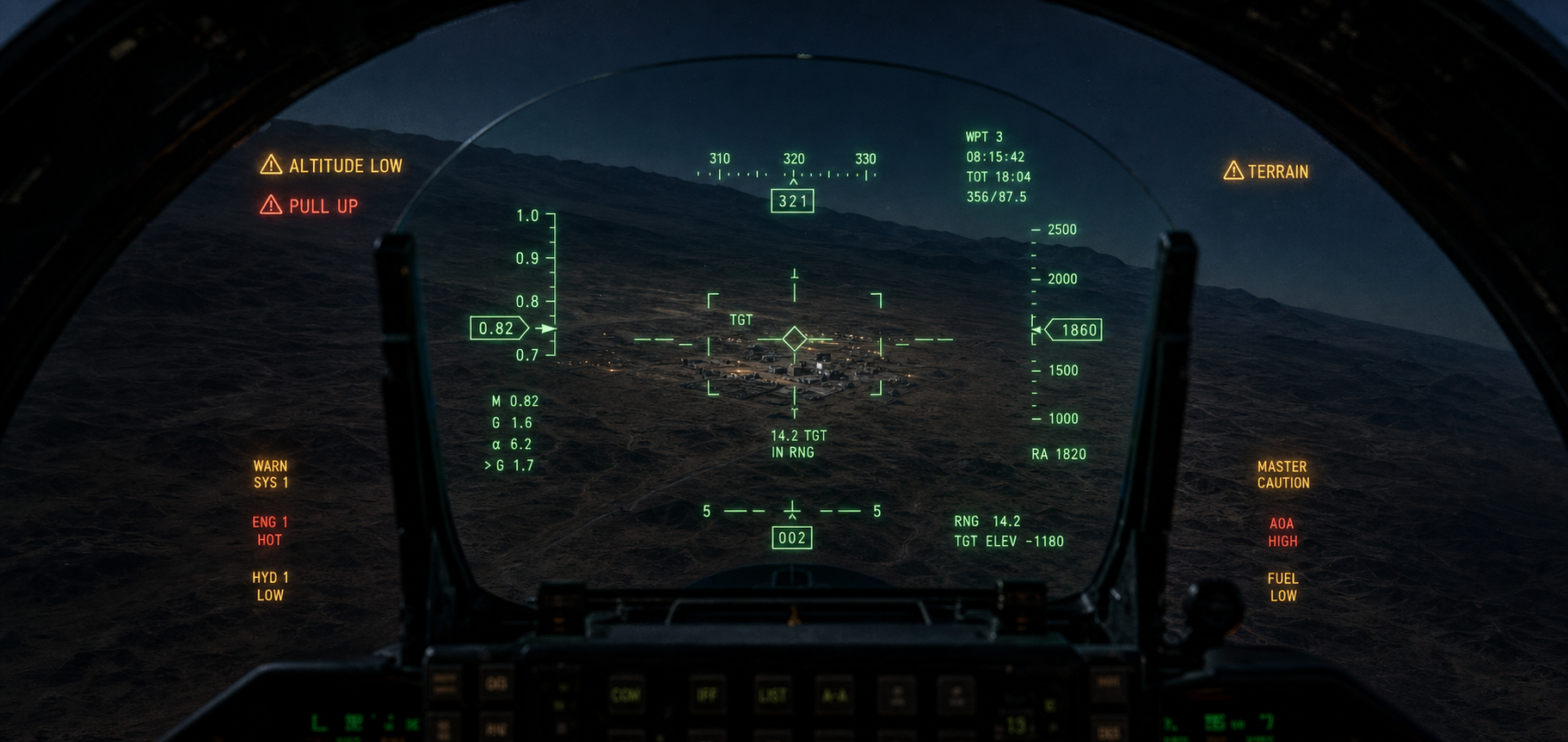
Gila Bend, Arizona. March of 1992.
I was an airman in the United States Air Force, a security policeman on my first tour of duty. I’d been stationed at Gila Bend since the previous October — five months on the ground — and this was my third aircraft-down incident.
It was the second fatal one.
The pilot was a Lieutenant Colonel. Thousands of hours in the cockpit. Not a rookie, not a student, not somebody in over his head. It was a night training mission. Routine. Air-to-ground target practice — the kind of thing this pilot had done in some form more times than most of us have driven to work. Nobody’s life or campaign was riding on it. It was just Tuesday.
Something on the run went sideways. From what we pieced together afterward, he was struggling to acquire the tone that told him he had a target lock. Instead of peeling off, coming around, and making another pass, he stayed on target. He kept fighting for the solution. He fought for it right up to the moment his aircraft became the ordnance.
The alarms would have been screaming. The instinctive flight skills he had built over decades would have been telling him to pull up. None of it registered. His entire mental world had shrunk to one problem: get the tone, get the lock, complete the pass. The map got smaller and smaller until it was smaller than the ground.
Airmen learn a word for this. Target fixation. It’s the specific failure mode where a trained operator locks onto the problem so hard that the warning system built to save them becomes background noise. It doesn’t happen to novices. It happens to experts. That’s what makes it dangerous.
That Lieutenant Colonel didn’t die because he was untrained. He died because he was so trained that his training became a tunnel.
The overnight
Fast-forward thirty years. Same failure mode, different uniform.
I’m in a data center at 2 a.m. with one of my senior engineers, running a paired-switch upgrade on a set of Cisco Nexus 9Ks. This is not a rookie mission. Overnight maintenance windows are his job. He’s done dozens. The change ticket is clean, the runbook is real, and we have a rollback plan we’ve used before.
One of the pairs doesn’t take the update the way it should. We land in a split-brain condition on a pair of switches that happen to service the storage fabric underneath our virtualization architecture. Which means: not just a switch problem. A storage problem. Which means: everything above it is now sitting on a shaky floor.
I open a bridge. I wake up leadership. The CIO comes on the line herself, which tells you everything you need to know about the size of the blast radius we were staring at. We are past two hours into the incident. My engineer is at the CLI, hunched over the keyboard, moving fast — issuing show commands, chasing configuration deltas, trying to reconcile what each side of the split brain believes about the world.
The CIO’s first real question isn’t about topology. It’s this:
“Is there a Cisco TAC case open?”
I turn to my engineer. He says no.
She says: “Tell him to stop everything else and open the case. Right now.”
I relay the order. I watch him nod. I watch him keep typing. Troubleshooting continues for another hour. Now we are three hours into the incident, and we are also three hours from the moment the CIO will have to decide whether we open branches and serve customers that day.
She asks me for a status on the TAC case.
I ask my engineer. No answer. I ask again. This time he looks up at me — and I remember the look — and he says, quietly:
“I haven’t opened it.”
He had never opened the case. In three hours of the CIO of a global business asking, and his incident commander relaying, and every warning bell in the room going off, he had not opened the case. Not because he was lazy. Not because he didn’t respect leadership. Because he was locked onto the target. His entire mental world had shrunk to the CLI in front of him. The map got smaller and smaller until it was smaller than the incident.
The pull-up-pull-up klaxon in that cockpit — that was the CIO’s voice on the bridge. And my engineer, one of the best I have ever worked with, could not hear it.
Why it happens to the good ones
Nobody target-fixates on their first day. You have to have been trained. You have to have won some fights. You have to have built the muscle memory that says I can solve this if you just give me a few more minutes. Target fixation is what happens when that muscle memory becomes the only voice in your head.
It is a failure of experts.
The junior engineer, four months into the job, is not going to sit at that keyboard for three hours ignoring the CIO. He is going to open the case in the first ten minutes because he doesn’t yet trust himself to do it alone. The senior engineer does trust himself. That trust is usually right. But when it’s wrong — when the problem is genuinely outside the shape of the ones you’ve beaten before — that trust is exactly what kills you.
Fortunately, in our case, nobody died. No hardware went up in a fireball. We opened the case. Cisco walked us through it. The eventual root cause turned out to be a single line of configuration. One line. Three hours of a senior engineer’s life, an incident commander’s night, and a CIO’s Tuesday morning — all spent chasing a problem whose solution was closer to Slingblade than to the Nexus config guide. Billy Bob unscrews the gas cap, looks in, and says flatly: “Ain’t got no gas in it.”
Nine and a half times out of ten, that’s the answer. The complex, elegant, deeply-technical thing we’re chasing is a decoy. The real cause is a checkbox somebody missed at 11 p.m. the night before. But you have to stop chasing long enough to look at the gas cap.
Four rules I’ve written on the wall since
1. Start with the big picture. Look at the whole map. Not the CLI in front of you — the whole map. What’s normal? What isn’t? What just changed? What did you just do? A senior engineer at hour two of an incident is often the worst-positioned person in the room to see the big picture, because they’ve been in the trees since minute one. Someone has to lift their eyes.
2. Ask for help. Get another set of eyes. And when they arrive, don’t contaminate them. This one costs the most pride and pays the most dividends. When you finally page a peer or open a TAC case, do not walk them through every dead end you’ve already been down. Their value is a clean read. The second you say “we already looked at that” you have handed them your target fixation. Give them the symptoms. Let them see it fresh. That is the whole point of having a second set of eyes.
3. Gather resources at the onset, not at the end. A TAC case can take an hour before an engineer even picks it up. That escalation ticket to the vendor at hour three should have been opened at hour one. The manager you finally called at 4 a.m. should have been on the bridge at 2:15. Fear of “wasting people’s time” is how incidents become disasters. Wake people up early. If it turns out to be nothing, they will forgive you. If it turns out to be something and you didn’t, they won’t.
4. Walk away. Disengage. Pull up. Take a short walk. This is the one that feels impossible in the moment and is worth more than the other three combined. Get up from the keyboard. Go outside if you can. Ninety seconds of not-typing does more for your problem than another ninety minutes of the same commands with slightly different arguments. If that Lieutenant Colonel had peeled off, made a turn, and simply reengaged the target, he would have lived past that night. Peeling off is not surrender. Peeling off is discipline.
Target fixation is a spiritual failure mode too
Now translate. This is where I want you to sit with me for a minute, because target fixation is not just a cockpit problem or a data-center problem. It’s a soul problem, and I think most of us are running it right now on something we haven’t named.
The sin you keep grinding on alone. The argument in your marriage you keep re-running in your head at 2 a.m. instead of at breakfast. The doctrinal position you have to nail down before you can worship. The wound you cannot stop diagnosing. The child you are trying to fix from across the country. The ministry you are grinding into powder because you refuse to peel off and make another pass.
We were built with a warning system. The Spirit convicts. Scripture instructs. Community speaks. The still, small voice pulls at the edge of the headset. All of it — designed to save us — becomes background noise when we lock onto the target. We tell ourselves we are almost there. We tell ourselves one more command. We tell ourselves God will be more pleased with the solve than with the pull-up.
He won’t.
Proverbs says it plainly: lean not on your own understanding. That is not a verse about intellectual humility in the abstract. That is a verse about the specific pathology of the trained, capable, competent believer who has locked onto a target and cannot hear the tower. It is a verse that says: peel off. Ask. Escalate. Someone else has eyes on the same fight, and their read is clean where yours is contaminated by three hours of trying.
My engineer did not open the case because he thought he could solve it. That is exactly why we do not confess. That is exactly why we do not ask for prayer. That is exactly why we do not call the elder, the friend, the counselor, the pastor. We think we can solve it. We are usually a single line of configuration away from a solution we cannot see because we are staring at the wrong screen.
The CIO on the bridge that night was not angry at my engineer. She was trying to save him. The rebuke — “open the case now” — was mercy in the voice of authority. That is what the Spirit sounds like most of the time in my life, if I am being honest. Not thunder. A firm voice saying stop what you are doing and get help.
Some of us have been locked on target for years.
Peel off. Make a turn. Ask for the tone again from a different heading. There is grace enough for another pass. There is not always another pass if you fly it in.
Unworthy, but His,
Nick
Scripture
“Trust in the LORD with all your heart, and lean not on your own understanding. In all your ways acknowledge Him, and He will make your paths straight.” — Proverbs 3:5-6, ESV

Leave a Reply