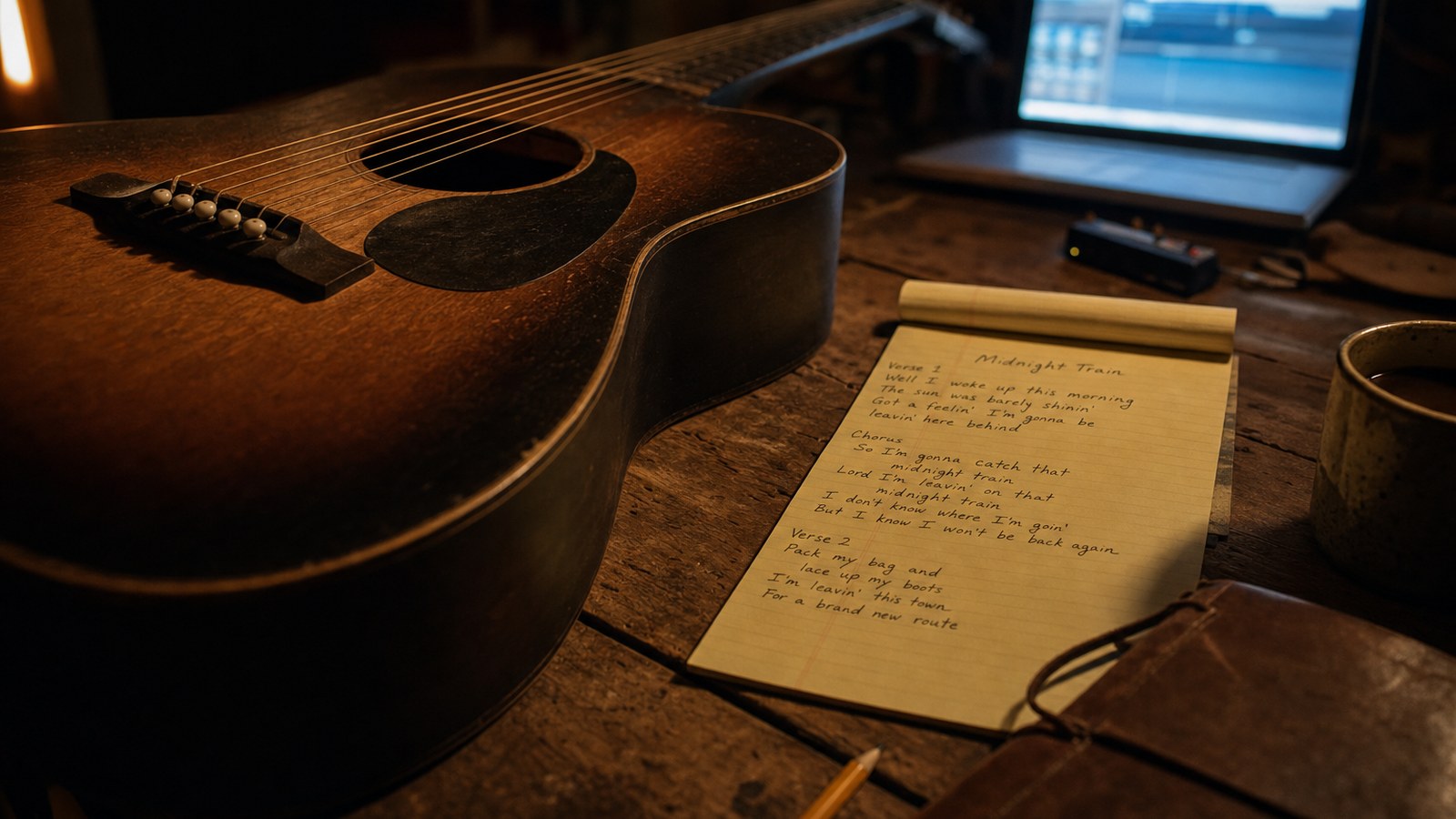
I opened Suno for the first time on a Tuesday night, right after finalizing the service plan for the upcoming Sunday. I had a lyric I’d been carrying for a few weeks — a prodigal piece I couldn’t get to sit right musically — and a guitar arrangement I’d worked out on the couch but never heard with a band. I described what I was hearing in my head: folk-gospel, fingerpicked, key of G, brushed snare, low harmony on the chorus. I hit generate.
Thirty seconds later I had four demo versions of my song. Vocals, arrangement, production, all of it. None of them were finished — that’s not what they were for. They were useful the way a rough sketch is useful: they told me the song actually worked. The arrangement I’d been hearing in my head wasn’t just in my head. I took one section, pulled it apart, rewrote the lyric, and by the end of the week, I had a song ready for transcription. It was my lyric, melody, chord progressions, structure, and inspiration. My copyrighted song. It could have been a (very talented) professional demo group, but I didn’t have budget for that. And yet…here it was. I cried — no, I wept. God had given me a gift.
I also felt vaguely guilty about it, and I’ve been thinking about why ever since.
Sousa Testified That the Phonograph Would Kill Music. He Was Half Right.
In June of 1906, John Philip Sousa — the march king, the man who wrote “Stars and Stripes Forever” — appeared before a joint session of Congress to oppose a new copyright bill that he believed would strip composers of control over mechanical reproductions of their work. That same year he published “The Menace of Mechanical Music” in Appleton’s Magazine, and the argument is worth reading in full if you have thirty minutes and a taste for righteous alarm.
Sousa’s concern had teeth. He worried that the phonograph would replace amateur musicianship in the home. That parents would stop teaching children to sing. That performers would be displaced by machines. “I foresee a marked deterioration in American music and musical taste,” he wrote, “an interruption in the musical development of the country.”
Some of that happened. Parlor singing — the Victorian-era practice of families gathering around a piano to sing together — essentially collapsed over the following decades. The phonograph, the radio, and eventually television moved music from participatory to consumptive. Sousa wasn’t wrong about that.
What he missed is that music didn’t die. It exploded. The phonograph industrialized distribution, which meant Bessie Smith and Louis Armstrong could reach ears in communities that would never see a concert hall. Recording technology didn’t kill musicianship; it created new kinds of musicianship and new economies around them. Sousa got the loss right and missed the gain entirely.
We’ve run this script several more times since then.
The Panic Is Old. The Question Is Whether This Time Is Different.
The Linn LM-1 drum machine shipped in 1980. The Roland TR-808 followed in 1981. Drummers complained — reasonably — that their livelihoods were being threatened. Session drummer income contracted. But the 808 also became its own instrument, and by the time trap music arrived, that kick drum sound had defined an entire genre. The technology that threatened one category of musician created new ones.
Cher released “Believe” in 1998. The Auto-Tune effect in the chorus was so aggressive that critics called it cheating. T-Pain leaned into it deliberately. Now every pop vocalist uses transparent pitch correction as a matter of course, and nobody thinks about it at all.
Sampling was “stealing” until it became the foundation of hip-hop. The legal apparatus caught up: in 2005, the Sixth Circuit ruled in Bridgeport Music v. Dimension Films that any digital sample of a copyrighted recording required a license. The ruling was blunt: “Get a license or do not sample.” Producers adapted. Sample-clearance became an industry. The music survived.
Pro Tools let bedroom producers compete with professional studios. The recording industry was supposed to collapse. It didn’t. It just moved.
So yes — the pattern is real. Every generation of music technology triggers a moral panic, most of the concerns have a kernel of truth, and the music survives.
Here’s where I have to be honest with you, though: generative AI is not just another drum machine. That framing sells the thing short in the wrong direction.
This One Is Actually Different (in at Least One Way)
Suno. Udio. AIVA. These tools don’t assist you in making music — they generate it. You type a prompt and receive a finished song: melody, harmony, arrangement, mixed audio, and in some cases lyrics. The creative leap from Pro Tools (“this helps you record and edit”) to Suno (“this generates the whole thing from a text description”) is not incremental. It’s categorical.
That distinction matters because it changes what disclosure means and what authenticity claims are possible. A drummer who practices for ten years and then uses a click track is still a drummer. A (wannabe) songwriter who types “write me a worship song about the prodigal son in the style of current CCM Top 40” and then posts the result to Spotify without telling anyone — that person is not a songwriter in any meaningful sense of the word. They’re a publisher of someone else’s output, where “someone else” is a language model trained on copyrighted recordings that the artists never agreed to license. Let me be clear: that is not how I use or condone the use of generative AI. Not even in this case, my first time using it. #integrity
That last part is the legal live wire right now. In June 2024, the RIAA filed copyright infringement suits against Suno and Udio in federal court, alleging that both companies trained their models on copyrighted recordings without licensing them. The cases are ongoing. The artists whose voices and arrangements may be embedded in these outputs didn’t sign off on it.
This is not a future problem. It’s a present one.
The Uses That Are Actually Wrong
Let me name the bad uses concretely, because vagueness lets people off too easily.
Passing off an AI-generated song as your own original composition without disclosure is a lie. The level of lie varies with context — posting it to SoundCloud is different from submitting it to a publishing house as your work — but it’s still a lie. The listener is being deceived about the nature of what they received.
Training generative models on copyrighted catalogs without licensing is — pending those lawsuits — likely infringement, and it’s certainly exploitation of artists who had no say in it. Using an AI tool whose training data was stolen is participating downstream in that theft.
Deep-faking an artist’s voice is a different category of wrong. In April 2023, a track called “Heart on My Sleeve” appeared online, featuring what sounded like Drake and The Weeknd on a track neither had recorded. The creator had used AI to clone their vocal performances. Universal Music Group had it pulled. It doesn’t matter how good it sounded; using someone’s voice without their consent to produce content they never agreed to is a violation of something that I think we’re still finding the words for.
Streaming farms that generate AI music at volume to collect royalties are fraud. That one’s simple.
And then there’s the category that matters most to me as a worship minister: using AI to generate a song and then claiming, implicitly or explicitly, that it came from a place of prayer and devotion. Every worship community I know of has a culture where songs are trusted because they come from somewhere real. “God gave me this song” is a claim about origin and authenticity. Laundering an AI output through that claim isn’t just plagiarism. It’s a particular kind of spiritual deception.
The Uses That Are Actually Fine
Here’s where I think the conversation gets too blunt. “AI music bad” isn’t a principle; it’s a panic dressed up as discernment.
I have used AI tools to mock up arrangements I couldn’t afford to commission yet. When I had a melody and chord chart and no way to hear it with a full band, generating a demo with synthesized strings and a rhythm track let me hear whether the arrangement I was hearing in my head actually worked. If it did, the song moved into the real process — stems, clicks, live players. If it didn’t, the song went in the file. Nobody was deceived either way. The AI was a sketch pad.
I’ve gone to a language model when I was stuck on a single line — needing a stressed syllable in a particular spot, or a rhyming synonym that kept the meaning intact. That’s an editing assist, not a co-writer. The lyric is still mine. The tool just helps me clean a seam.
Songwriters who can’t play an instrument have always needed someone to realize their melodies. A lyricist who can hear a melody but can’t notate it now has options that didn’t exist three years ago. That’s not a threat to songwriting; it’s an accessibility ramp.
In worship specifically: generating placeholder backing tracks for a rehearsal when half the band can’t make it is a legitimate and frankly obvious use. Using an AI tool to draft psalm paraphrases as raw material — the way you’d use a commentary or a rhyme dictionary — gives you something to push against. The work of wrestling with the text, finding the hinge, writing toward God rather than about your feelings: none of that gets outsourced. The tool speeds up the part that was always mechanical.
The Actual Ethical Line Is Disclosure
The test isn’t whether AI touched the song. The test is whether the listener would feel deceived if they knew exactly how it was made.
A producer who generates a string arrangement with AI and then re-records it with live players isn’t deceiving anyone. The arrangement informed the session; the session produced the recording; the recording is what it is. A worship leader who generates a complete song with Suno, learns the melody by listening on repeat, and presents it to a congregation as their own prayer — that person is deceiving the congregation about something that matters.
Disclosure is the ethics here. Not perfection of process. Not a purity test about which software you used. The question is whether you’re being honest with the people who are trusting you. That standard is workable — it’s the same one that applies to ghost-writing, co-writing, and session musicianship. The music industry navigated those. We can navigate this.
Sousa Lost the Phonograph Fight, and Music Got Bigger
The hammer doesn’t sin. The hand does. AI is a tool, and tools take on the character of the hands that use them — the intentions behind them, the honesty or dishonesty of how they’re deployed, the care or carelessness of the work that surrounds them.
Sousa was right that mechanical music would change the relationship between people and music. He was wrong that the change would be catastrophic. The phonograph took something away and gave something back. Same with the drum machine, same with Auto-Tune, same with Pro Tools, and same — I think, eventually — with generative AI.
The panic is understandable. The question worth sitting with is whether we’re going to engage it honestly or just react to it. Because the people who refuse to learn the tool will cede that ground to the people who will use it without the ethics. I’d rather it be the other way around.
Sousa lost the phonograph fight. We’re not going to lose this one by pretending it’s not happening.
Unworthy, but His,
Nick
Scripture
“All things are lawful, but not all things are helpful. All things are lawful, but not all things build up.” — 1 Corinthians 10:23, ESV
Leave a Reply