For Dad.
We were about ten years old and we hadn’t slept.
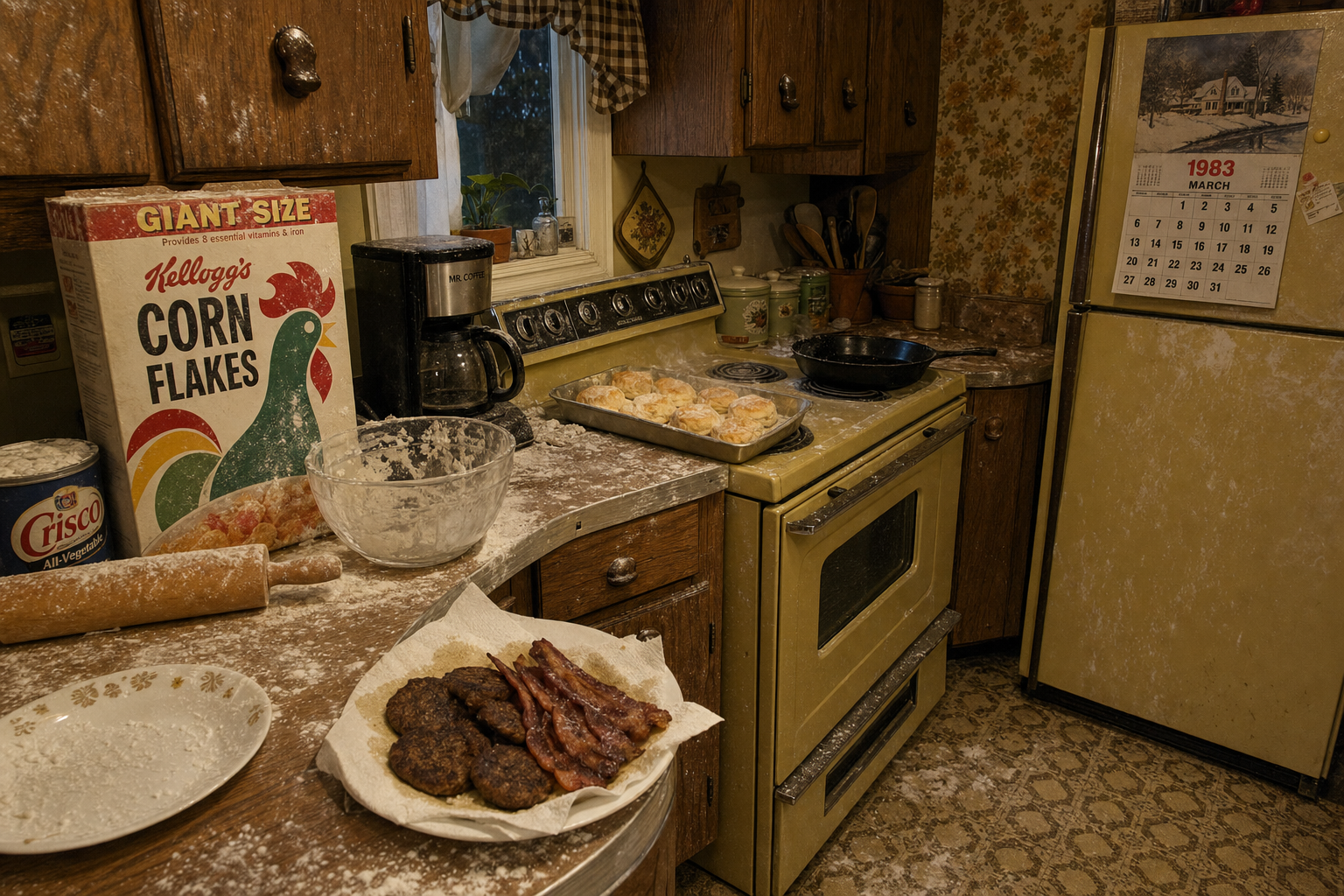
Radford had come over for the night and we made the classic sleepover miscalculation: we stayed up. All of it. Somewhere around 4 a.m., in that specific delirium that only kids on a sleepover know, we decided we were going to make my parents a full breakfast before they woke up. Not cereal. A full breakfast. Coffee. Scrambled eggs. Bacon. Sausage. And — because apparently we hated ourselves — homemade biscuits.
We had never made biscuits.
Radford lived with his grandparents, and his grandma was up before the sun most days, so we called her. She walked us through it. Flour, buttermilk, cold butter, a light touch, don’t overwork the dough. My kitchen at 5 a.m. looked like a flour bomb had gone off in a diner. Flour on everything from the refrigerator to the floor. Lard on the ceiling. I am not exaggerating. On the ceiling.
My dad walked in mid-bake.
He looked at the state of his kitchen, looked at the two kids covered in the ingredients, looked at the ceiling, and the look on his face made it very clear that the situation had entered a new phase. He sent Radford home. Then he took off his belt.
I don’t remember how many licks. I remember that he used each one to tell me, out loud and in cadence, exactly where I had gone wrong. The lard. The flour. The ceiling. The mess. The fact that we hadn’t asked. The fact that we’d woken the whole house. Each mistake got its own lick. I cried. Real crying, the kind that only a ten-year-old with flour on his cheek can do.
Then the biscuits came out. So did the eggs, the bacon, the sausage, the coffee. My mom came in. She sat down and ate. My dad sat down and ate.
Then my dad did something I have thought about for almost forty-five years.
He came and found me, and he apologized. He said the breakfast was incredible. He said the biscuits — he was specific about the biscuits — were the best he’d had in years. He’d panicked at the mess, he told me, and he’d missed what the mess was actually producing.
The mess and the meal were the same thing. He just couldn’t see it while the flour was still floating in the air.
The forklift
Fast forward to 2024. I’m sitting in a project kickoff for a full network refresh across seventy sites. Cisco out, Fortinet in — a top-to-bottom forklift of SD-WAN and campus LAN. Every branch, every closet, every uplink, every failover path. Seventy sites means seventy cutover windows, seventy sets of local hands, seventy chances for something specific and unpredictable to go sideways on a Tuesday at 2 a.m. local time.
If you’ve never sat in a project like this, here’s the honest sales pitch: it is going to be messy. There is no path from the old architecture to the new one that doesn’t run through a mess phase. You can plan for it. You can shrink it. You cannot skip it.
The executives asking the question — “how long, how much, how many people, when do we see clean dashboards again” — are asking a completely reasonable question. It’s just not the right question for the shape of the work. The right question is: are we sequencing the mess, or is the mess sequencing us?
Standardize, then repeat, then adjust
How do you eat an elephant? One bite at a time.
The way you eat this elephant is you build one plate and then you build seventy of the same plate.
Site 1 is the sacrificial site. Not the smallest, not the biggest — something representative. You do the design, the BOM, the pre-staging, the cutover runbook, the rollback plan, the post-cutover verification checklist. And then you actually do it. Live. With real users and real traffic and real 2 a.m. surprises. And the first one is ugly. It always is. VLAN mismatches you didn’t anticipate. A printer VLAN somebody forgot to document in 2018. A firewall rule that was doing something load-bearing that nobody remembered writing.
You fix it. You update the runbook. You annotate the surprises. Site 2 goes a little smoother. Site 3, smoother still. By site 7 or 8, the runbook is real. By site 20, the local hands know what to expect. By site 50, you’re running two sites a week in parallel and the biggest problem is scheduling around a store manager’s vacation.
Site 70 is not seventy times harder than site 1. Site 70 is easier than site 1, because by the time you get there, the mess has been metabolized into a pattern. That’s the whole game.
The mess phase is not the failure
Here is where most large projects die.
Not at kickoff. Not at go-live. In week 3, when the ugly early sites are the only data points anyone has, and someone senior gets a bad taste of the transition and starts asking whether we chose the right vendor, or whether we should pause, or whether we should re-scope, or whether we should bring in a different SI to “take a look at things.”
I have watched perfectly viable transformations get killed in week 3. Not because the work was wrong. Because the leadership couldn’t sit with the mess long enough to let the pattern emerge. They panicked at the flour on the ceiling and missed the biscuits in the oven.
The discipline in the mess phase is not “everything is fine.” That’s a lie and the team knows it. The discipline is: this is the shape of the work. We planned for this. We’re inside the runbook, not outside it. The next site is going to be a little better because of this one. That sentence, said with a steady voice in a room full of anxiety, is what a leader is actually for during a forklift.
Trust the runbook. Trust the pattern. Fix what needs fixing. Don’t rip the oven open every ninety seconds to check.
What God is not doing
Now translate.
Anyone who has ever tried to become a different kind of person knows the mess phase. Anyone who has tried to repair a marriage. Anyone who has tried to walk a friend through grief. Anyone who has tried to plant a church. Anyone who has tried to rebuild a life after a layoff, or after a diagnosis, or after burying a parent.
The mess is where most of us decide to quit. Because we look at week 3 of the work God is doing in us and we conclude that either He isn’t doing it, or He picked the wrong project, or He’s abandoned the runbook. We panic at the flour on the ceiling and we assume no biscuits are coming.
But God is not panicked by the mess phase. He’s not surprised by site 1 being uglier than site 70. He built the sequencing. He wrote the runbook. He knows exactly how many surprise printer VLANs are hiding in your soul from 2018, and He has already priced them into the timeline.
Paul says God is working in us to will and to do His good pleasure. Present tense. Ongoing. That’s a forklift, not a firmware update. It has a mess phase. And the mess phase is not evidence of His absence. Very often it’s evidence of His work.
My dad apologized after breakfast. Not before. Not during. After. He couldn’t see what the mess was producing while it was producing it. But it was producing something the whole time.
I don’t know where you are in your forklift. Maybe you’re at kickoff and you’re overwhelmed by the scope. Maybe you’re at site 3 and you’re pretty sure you picked the wrong vendor. Maybe you’re at site 40 and it’s starting to feel routine and you’re wondering when the miracle happened. Maybe you’re at site 70 and someone should tell you the biscuits were incredible.
Wherever you are: let it cook.
Unworthy, but His,
Nick
Scripture
“For it is God who works in you, both to will and to work for his good pleasure.” — Philippians 2:13, ESV
Leave a Reply