How I Use AI in My Songwriting
Hip-pocket backup — unscheduled. Personal-workflow companion to post #189 (AI ethics in songwriting). v2 — edited 2026-05-21.
I write lyrics. (I always begin with lyrics.) Sometimes the inspiration comes directly from Scripture. Sometimes God uses a sermon or a Sunday school lesson, the way He did with “Man On the Middle Cross.” I’ve written about personal experiences — “I Love You, Too” came after the loss of my dad — or the experiences of friends and family. But my favorite is when it’s just the still, small voice of the Holy Spirit. Always words first.
I don’t have a reason for that order. It’s just how I operate. I do find it more liberating to write when I’m not bound strictly by time signatures and bar counts. But even then, I can get stuck. (I get stuck a lot.) In those moments, I may go to an LLM and play with phrasing options, rhyming synonyms, and syllable counts.
Here’s what that actually looks like. I had a chorus line a few weeks back: He carried what I couldn’t / and called it grace enough. The second line was a syllable short and the rhythm landed wrong against the melody I was hearing. I asked an LLM for ten variations that ended on a stressed syllable and kept “grace” in the line. About seven of them were useless. Two were close. One — and named it grace enough — was better than what I had. I kept it. The inspiration was mine; the assist was mechanical, the way a thesaurus is mechanical. The Spirit gave me the line. The tool helped me clean the seam.
From Lyric to Melody
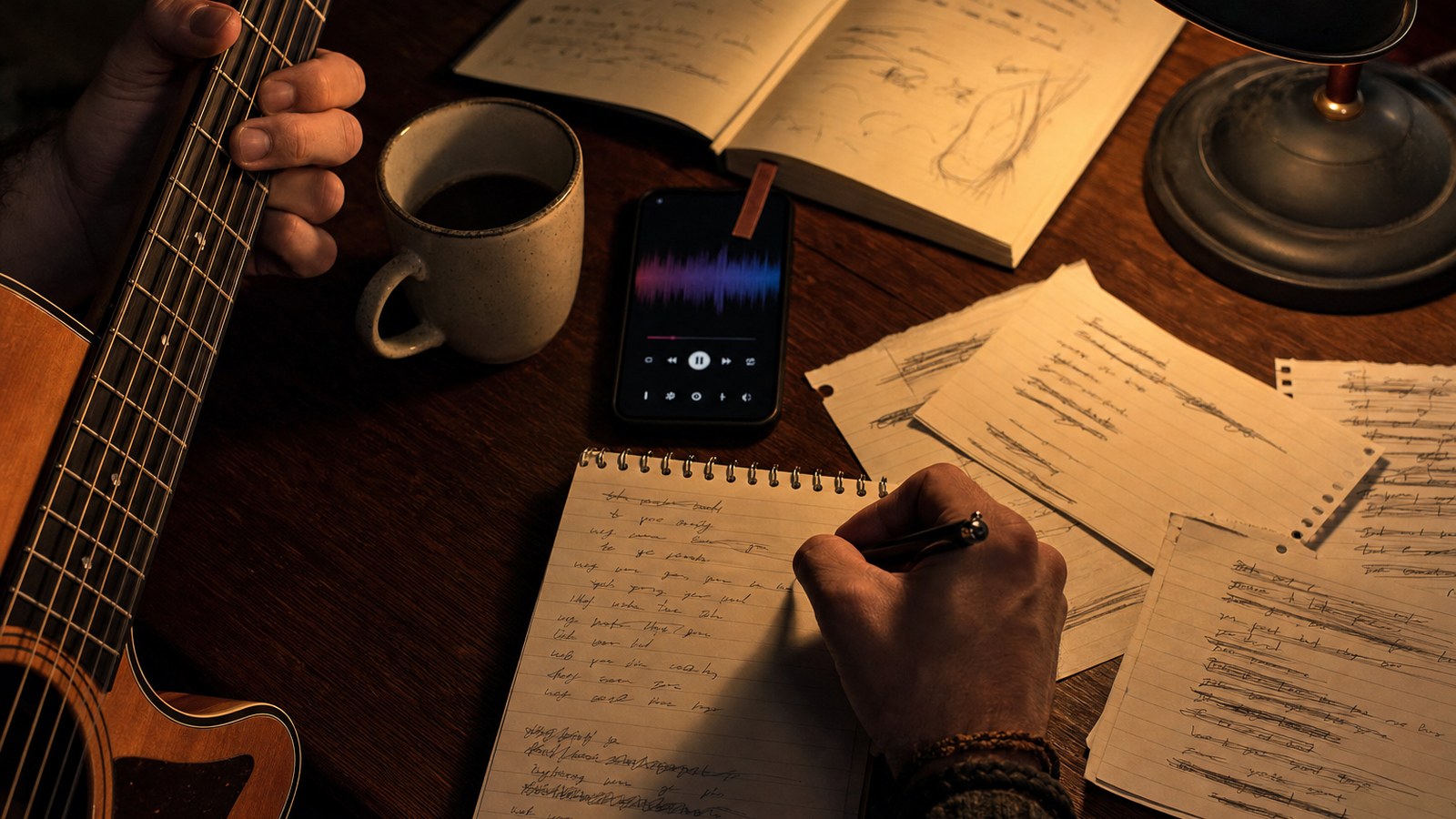
From the lyrics — whether it’s a chorus, a single verse, or an entire song with arrangement — I pull out the guitar or sit at the keyboard and start laying melodies over chords. Harmonies come naturally; I usually hear the third or fifth before I’ve finished playing the lead line through. I don’t know how to explain that any other way than to call it a gift.
There may be eraser dust all over my lap before I’m done. Or I may just play through one time and walk away. Or the inspiration hit me with phone in hand, in which case — yeah, it is genuinely frustrating trying to add chords to a Note on an iPhone with just my thumbs.
So whether it takes a few hours (my personal best is fifty-three minutes) or weeks, or even years, I’ll get the song to a complete first draft. I record just me and a guitar, usually, and play it back.
I may or may not make more edits. But when it feels like a song — that’s when I bring in the tool.
The Suno Step (and the Rabbit Hole)
Generative AI tools like Suno let me hear what a song can be. That matters because I’ve gotten this far with a lot of songs only to file them away, because they just didn’t work musically the way I thought they would. I’d hear them in my head as folk-gospel with a full band; in real arrangement they’d land closer to a dirge. Better to find that out before I commission stems than after.
So I’ll generate a few versions — different feels, different instrumentation, different tempos — and listen for the one that confirms what I heard in my head. That’s the actual function. I’m not asking the AI to write me a song. I’m asking it to tell me whether the song I already wrote is one worth recording.
Now, I say this both as a confession and as a word of warning: this can be a rabbit hole. Before you know it, an hour has passed and there are thirty-six versions in a playlist. And that’s when you have to set it down, walk away, and reset. Some things just can’t be brought to life. Call it: time of death, 3:14 a.m.
But when it hits — wow. It is invigorating to hear it completely put together. It makes me feel the way I did when my oldest graduated from high school. That exuberance that comes from the thought, that actually came out of me. (Make no mistake — all glory to God.)
What I Won’t Use AI For
Because I keep getting asked, let me name the lines I don’t cross.
I don’t have AI write the lyric. The lyric is the prayer, and the prayer is mine. Using an LLM to clean phrasing is closer to editing than writing; using it to generate the idea is something else entirely, and I won’t do it.
I don’t generate the melody from a prompt. The melody has to come from the instrument under my hands. If I can’t find it on the guitar or the keyboard, the song isn’t ready.
I don’t present a Suno output as a finished song. The AI demo is a sketch — a mock-up to test whether the arrangement works. The actual recording has real players on it.
And I don’t claim, implicitly or otherwise, that an AI-assisted song came from a place of unmediated prayer. If the tool touched the production process, I’m honest about that with the people I share the song with.
From “Feels Like a Song” to Finished
When the demo confirms the song is real, I commission someone to help me with stems and clicks. That becomes the basis for my acoustic parts, then lead and harmony vocals, then friends, team members, or paid pros laying in instrumental parts. From there it goes to a producer, and for many of them, to someone who can transcribe charts. When timing demands it, I’ll send the AI demo to the transcriber along with my notes — clearly labeled for what it is.
AI is a tool. Like any tool, it can be used correctly or misused. The distinction between ethical use and cheating is pretty easy to discern if you’re being honest with yourself: ask whether the people listening would feel deceived if they knew exactly how you got here. If the answer is no, you’re fine. If the answer is yes, the tool isn’t the problem.
When the demo finally comes back the way I heard it in my head, that’s not the song. The song was already there. The demo just tells me I wasn’t crazy.
Unworthy, but His,
Nick
Scripture
“Every good and perfect gift is from above, coming down from the Father of lights, with whom there is no variation or shadow due to change.” — James 1:17, ESV
Leave a Reply