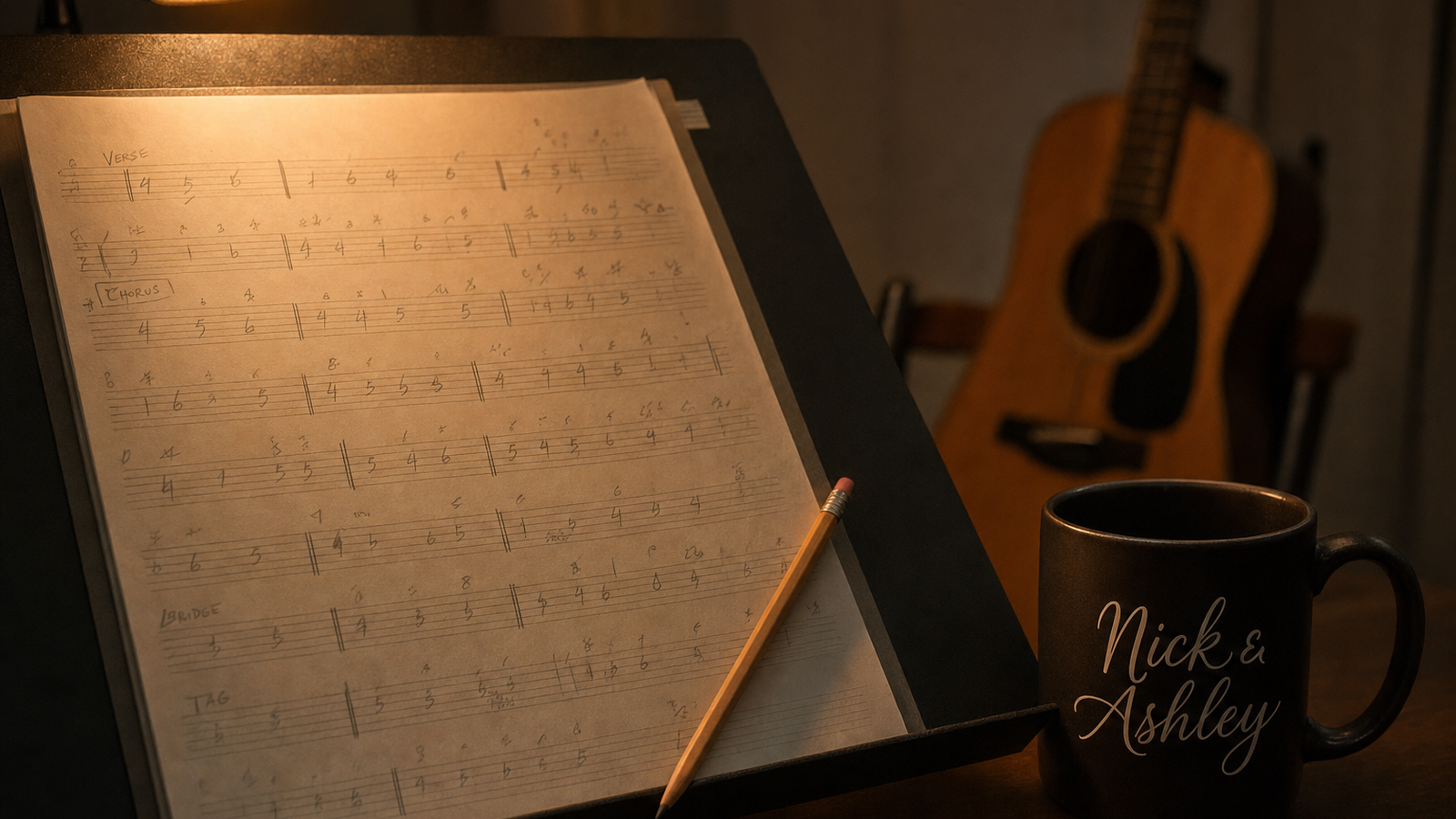
Most of the songs I’m proudest of writing are songs the room doesn’t want to sing.
That’s not me being edgy. It’s just what happens when you sit down honestly with the year you’ve actually had. Layoffs. Funerals. A friend who walked away from the faith. A medical chart you didn’t ask for. The week your marriage was held together by stubbornness and a single thread of grace. None of that material naturally produces a four‑on‑the‑floor anthem with a key change.
And yet, those are the songs I keep writing. Not because I think every Sunday should feel like a funeral, but because I think the church is starving for songs that name what’s actually in the room.
The hymnbook the Bible actually gave us
The Psalms are not a worship‑set rotation. They’re a hymnbook. They’re the hymnbook the Spirit handed the church and said, here, sing this. And roughly a third of them are laments.
“How long, O Lord?” “My God, my God, why have you forsaken me?” “I am weary with my crying out; my throat is parched.” Those lines are scripture. They got canonized. Someone in Israel sat down with a harp and a real grief and wrote them, and the people of God sang them in public, on purpose, for centuries.
Compare that to the average modern worship set. I love a lot of those songs. I’ve written and led a few. But if a Martian walked into a Sunday service and tried to reconstruct human experience from the lyrics, he’d conclude that everyone in the room was doing fine, had always been doing fine, and would continue to do fine forever. He’d miss the entire reason any of us are there.
The line between lament and self‑pity
Here’s where I have to be honest. The reason a lot of churches don’t program lament isn’t squeamishness. It’s that bad lament is awful. It mopes. It wallows. It makes the singer the protagonist and God a kind of supportive friend in the background. It manages to be sad without ever being honest, which is a neat trick.
Real lament does something different. It tells the truth about the situation, and then it turns. Almost every psalm of lament has a hinge — a “but” or a “yet” or a “nevertheless” — where the singer stops describing the wound and starts addressing God. The wound doesn’t get smaller; the audience changes. Suddenly the song is no longer me reciting my pain to a room. It’s me handing my pain to the only one who can do anything with it.
That hinge is the difference between a worship song and a journal entry set to music. If I’m writing and I can’t find the hinge, the song isn’t done. It might be a true sentence. It is not yet a song the church can sing.
Three rules I write by
I’m not going to pretend I have a system. But when I’m working on a hard song, three things keep me from sliding off the cliff.
- Name the thing. Not “the trial.” Not “the valley.” The thing. Cancer. Layoff. The empty chair at Thanksgiving. Specificity is what makes a song land — and, paradoxically, what makes it usable for someone whose specifics are different. People connect to honest detail, not generic gloom.
- Address God by name, not by feeling. The minute the song stops being about how I feel and starts being to the One who can answer, the room can join in. As long as I’m just describing the dark, I’m a soloist. The second I sing toward Him, it becomes a congregation.
- End where the gospel ends. Not necessarily resolved. Not necessarily happy. But anchored. Even Psalm 88, the bleakest song in the Bible, is sung to God, in covenant, by someone who refuses to walk away. That’s the floor. The song can be sad. It cannot be hopeless. There’s a difference.
What this sounds like in real songs
Listen for the hinge in songs you already sing. “Run to the Father” is a clean example. The verses name the weight — “I’ve carried a burden for too long on my own / I wasn’t created to bear it alone” — and then the chorus changes the direction of the song. The wound doesn’t get smaller. The audience changes. That’s the move. Three minutes of Hebrew poetry in a CCM package.
I tried to write toward the same discipline in a song called “Alone.” The verses are honest about a real category of pain — the failed spiritual search, the years of trying to fill the void with everything but God. “Nothing seemed to satisfy.” “I don’t know how to pray / but I’m desperate for a way.” That last line was the one I had to sit with the longest, because admitting you don’t know how to pray is the kind of thing you’re not supposed to admit out loud in church.
The hinge in “Alone” is doubled. First the seeker breaks and prays — that’s the standard psalm move. But then God answers, in His own voice, and the song shifts from monologue to dialogue. And what He says is not what the CCM playbook would have written. “I won’t promise you a life apart from struggle.” He doesn’t oversell the deal. He just promises His presence. By the final stanza, the “I” has become a “we” — because that’s what happens when one person’s lament gets answered. The room can sing it.
I don’t put “Alone” up against “Run to the Father.” Cody Carnes can sing. I’m a guy with a notebook. But the discipline is the same: name the thing, address God by name, end anchored. If a song does those three, it can be sad. It will not be hopeless. The room will follow it.
Why the church needs this on a Sunday
Every week, people walk into our service who buried someone on Tuesday, got the diagnosis on Wednesday, lost the job on Thursday, and sat through a brutal conversation with a teenager on Saturday night. If the only songs we hand them are songs about how good things are, we are quietly teaching them that the room they just walked into is not a room where their actual life is welcome.
That’s not a music problem. It’s a pastoral problem. And a worship leader who never programs a lament is, however unintentionally, telling half the room to leave the worst part of their week in the parking lot.
The hard songs are not the whole diet. They aren’t supposed to be. But they belong in the rotation. They’re the songs that say, in front of God and everybody, that the gospel is big enough to hold what is actually happening to us — and that the people of God have been singing through this kind of week for three thousand years.
So I keep charting them. I keep handing them to my wife and asking her to tell me where the song is dishonest, or melodramatic, or trying too hard. I keep cutting verses. I keep looking for the hinge. And every once in a while, one of them lands in a service and somebody finds me afterward and says, quietly, “I needed that song this week.” The first time it happened to me was after we led “Alone” on a Sunday I don’t want to describe in detail. A man I’d never met came up afterward with red eyes and said exactly that. He didn’t need the song to fix anything. He needed it to name something. That’s what the hard songs do.
That’s the whole job.
Unworthy, but His,
Nick
Scripture
“How long, O Lord? Will you forget me forever? How long will you hide your face from me? … But I have trusted in your steadfast love; my heart shall rejoice in your salvation.”
Psalm 13:1, 5, ESV


Leave a Reply